
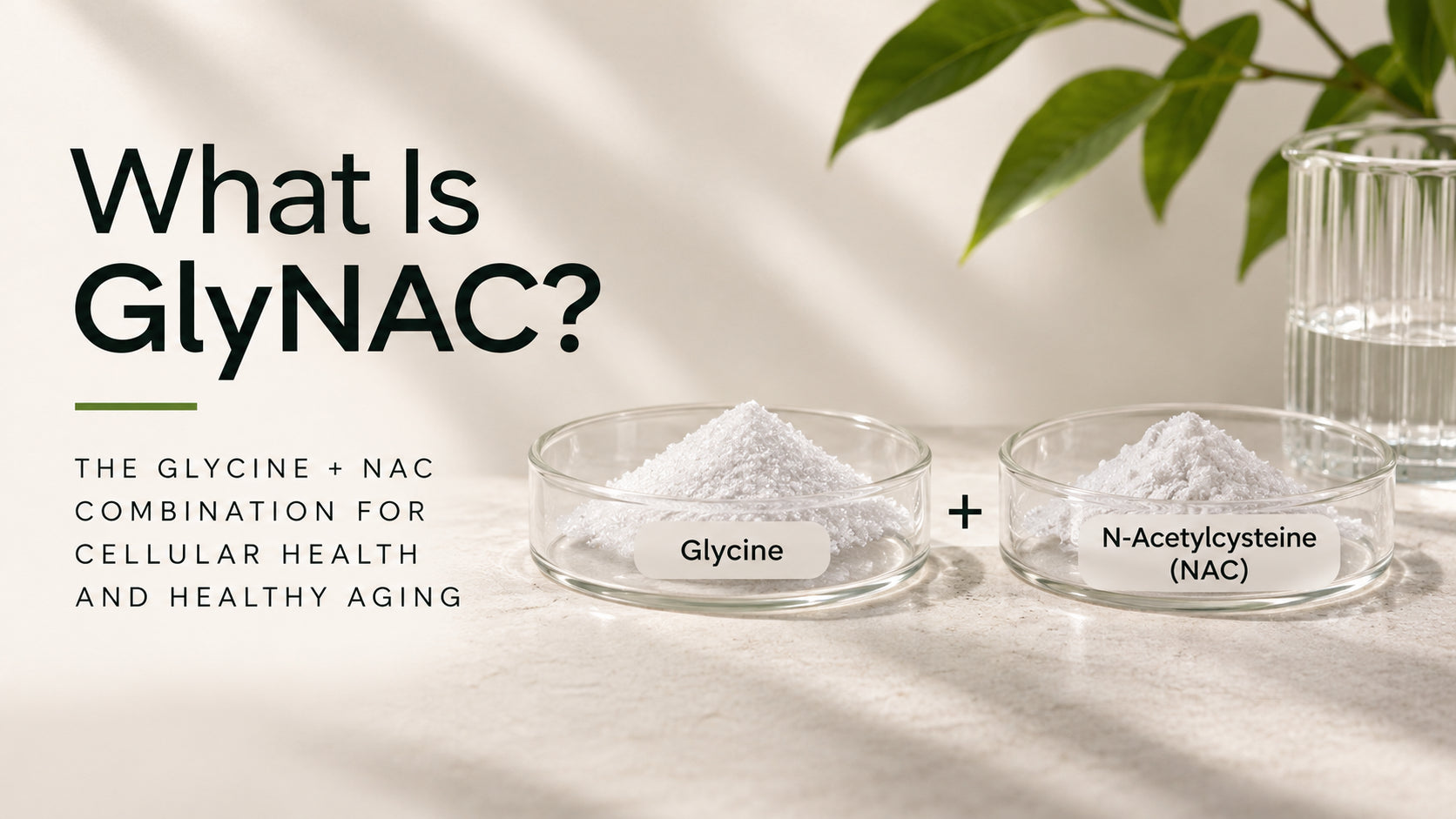
GlyNAC is a simple name for a supplement combination of glycine and N-acetylcysteine taken together. People usually look it up because they want a plain-English explanation of what the ingredients are, how the pairing is thought to work, and why it comes up in discussions about healthy ageing and antioxidant support. This article is for general education only, so it is not a diagnosis, treatment plan, or personal medical recommendation. Instead, it gives you a clear overview of the formula, the research themes around it, and the practical points to consider before trying it.
What GlyNAC is and why people use it
At its most basic, GlyNAC is an amino acid supplement pairing that combines glycine and N-acetylcysteine. The idea is straightforward: both ingredients are involved in the body’s ability to make glutathione, one of the main antioxidants used in cellular defence. That is why GlyNAC is often discussed in the context of cellular health, oxidative stress, and healthy ageing rather than as a general “energy” product. Many people first encounter it because of ageing research, but the supplement itself is usually framed as a support tool, not a cure or a replacement for medical care. If you are trying to understand What is GlyNAC, the key point is that it is a two-part formula built around a specific biochemical pathway.
People tend to use GlyNAC for one of three reasons: they want to learn what the ingredients do, they are interested in the science around glutathione, or they are looking for a simple daily supplement format. That can include powder or capsules, depending on preference. The important thing is to keep the expectation realistic. Research interest does not automatically mean proven outcome for every person, and benefits may vary depending on diet, health status, age, and overall routine. For that reason, it helps to think of GlyNAC as a general supplement overview topic first, and only then as a product choice.
What is inside GlyNAC?
Glycine as the first building block
Glycine is a non-essential amino acid, which means the body can make it, but it also comes from food. In the GlyNAC pairing, glycine matters because it is one of the raw materials used to build glutathione. That makes it more than just a standalone amino acid in this context. When people talk about glycine in supplement discussions, they are usually referring to its role as a building block rather than a dramatic standalone effect.
From a practical point of view, glycine is part of the “supply” side of the equation. If the body is trying to produce more glutathione, it needs the right ingredients available at the same time. Glycine is often included because it can help fill that requirement. It is also one reason GlyNAC is viewed as an equal-proportion blend formula in many discussions: the pairing aims to support the same pathway from two different angles.
N-acetylcysteine as the cysteine source
N-acetylcysteine, often shortened to NAC, is a source of cysteine. Cysteine is another key building block needed for glutathione production. In simple terms, NAC helps provide the sulfur-containing part of the mix that the body can use in this pathway. This is why you will often see the phrase glycine and N-acetylcysteine in educational material: both ingredients matter for the same end goal, but they contribute in different ways.
The pairing matters because a shortage of either ingredient can limit the body’s ability to make glutathione efficiently. That does not mean everyone is deficient, and it does not mean the supplement is necessary for all adults. It does mean the combination has a clear logic. Glycine contributes one building block; NAC supplies the cysteine source. Together, they support the pathway that researchers study when they look at antioxidant defence and glutathione synthesis.
How GlyNAC works in the body
Glutathione synthesis and antioxidant support
The main explanation for how GlyNAC works starts with glutathione production. Glutathione is a naturally occurring antioxidant that helps the body manage internal stress from normal metabolism and environmental exposure. Glycine and NAC together are thought to support the raw materials needed for glutathione synthesis, which is why GlyNAC is often discussed as a way to support the body’s own antioxidant systems rather than as an antioxidant itself.
In broad terms, this means the supplement may help the body maintain or restore glutathione levels when supply is limited. That is the core mechanism used in most discussions of GlyNAC. Researchers are interested in whether improving this pathway may also influence energy metabolism, because antioxidant balance and cellular energy production are closely linked. Still, it is better to describe this as a proposed mechanism rather than a guaranteed outcome. The science is active, but it is still developing.
Free radicals, oxidative stress, and cellular health
Another way to understand GlyNAC is through the lens of free radicals and oxidative stress. Free radicals are reactive molecules the body produces during normal life processes. When they build up faster than the body can manage them, oxidative stress can increase. That is one reason glutathione gets so much attention in ageing research: it helps the body respond to that ongoing load.
Because of this, GlyNAC is often linked to cellular health and, in some research discussions, to mitochondrial dysfunction as a possible pathway of interest. Mitochondria are involved in energy production, so researchers ask whether supporting glutathione availability may also help the cell handle stress more effectively. This is a proposed pathway, not a proven cure target. It is also why older adults are frequently studied: glutathione balance, oxidative stress, and cellular resilience are all common topics in ageing research.
Why glycine and NAC are often taken together
How the combined approach differs from using one ingredient alone
The phrase glycine and NAC together reflects a simple idea: if the body needs both ingredients to make glutathione, then supplying only one may not address the whole bottleneck. In supplement discussions, this is sometimes called a synergy concept. The logic is not that the combination magically creates a new effect, but that it can better support the same pathway than either ingredient alone in certain contexts.
That is why GlyNAC is usually presented as a pathway-focused supplement rather than a general wellness blend. The value of the pairing is tied to the glutathione pathway, not to broad promises about every aspect of health. For first-time readers, that distinction matters. The supplement makes the most sense when you understand it as a targeted precursor combination.
Potential health benefits under study
What research suggests so far
The current research conversation around GlyNAC is mostly about potential health benefits, not settled clinical conclusions. Studies have explored whether supporting glutathione production may influence markers related to oxidative stress, cellular resilience, and overall physiological function. That is why you will often see it discussed in mitochondrial research and in studies looking at age-related changes. The evidence is interesting, but it is still developing, and results should be read carefully.
Older adults are a major research focus because ageing is often associated with lower glutathione availability, more oxidative stress, and changes in metabolic flexibility. That does not mean every older adult has the same needs or responds the same way. It does mean researchers are trying to understand whether this ingredient pair can support broader health markers over time. For consumers, the useful takeaway is that the current conversation is about support and association, not guaranteed improvement.
Possible effects on energy, muscles, and cognition
Some of the commonly discussed areas include exercise capacity, muscle strength, and cognitive function. These topics appear because energy metabolism, oxidative stress, and mitochondrial function are all relevant to how the body feels and performs. If a supplement helps restore a key antioxidant pathway, researchers want to know whether that also shows up in daily-function markers.
There is also interest in how GlyNAC might relate to general fatigue, physical performance, and mental clarity in older populations. However, these are not promises. Research results can vary by population, study length, and dose, and they should not be treated as a guarantee of noticeable effects. The best way to interpret this area is as an early-stage look at possible support for health span rather than a claim that it will change health outcomes for everyone.
What research says about aging and age-related conditions
Oxidative stress, inflammation, and health span
A large part of GlyNAC’s popularity comes from its place in research on ageing and age-related diseases. Studies often focus on oxidative stress, inflammation, and metabolic markers because these are common themes in healthy ageing science. The idea is not that one supplement solves ageing, but that supporting glutathione may help the body respond better to stresses that accumulate over time.
Researchers also look at insulin resistance and endothelial dysfunction because they are relevant to cardiovascular and metabolic health. Endothelial function matters because the endothelium helps blood vessels respond properly to changing demands. Again, this is an area of study, not a treatment claim. Benefits, if present, may depend on continued use and may not persist after stopping supplementation, which is an important practical point for anyone reading about long-term use.
Markers often discussed in older adults
In older adults, GlyNAC research often tracks changes in oxidative stress markers, inflammation-related measures, and broader indicators of cellular resilience. That gives researchers a way to see whether the supplement may influence the background processes that shape ageing. The focus is usually on measurable markers rather than one isolated symptom.
This is also why the conversation can sound broad. The same glutathione pathway may be relevant to energy, tissue stress, and recovery, so researchers explore several endpoints at once. That breadth is useful, but it can also be confusing if you are expecting a simple yes-or-no answer. The most accurate way to read the evidence is as an evolving picture of how glutathione support might contribute to healthier ageing over time.
Research areas commonly linked to GlyNAC
Mitochondrial function and energy metabolism
One of the most repeated themes is mitochondrial function. Because mitochondria are central to energy production, researchers examine whether better antioxidant support may help cells run more efficiently. This is where GlyNAC is often connected to energy metabolism and to the broader idea of cellular efficiency. The interest is understandable, but it remains an area of ongoing study rather than settled guidance.
As with many supplements in ageing research, the underlying question is whether improving a basic biochemical pathway leads to meaningful changes in how the body functions. That is why the language around this area should stay cautious. Early findings can be promising without being definitive.
Liver research, cardiovascular health, and depression research
Beyond energy metabolism, GlyNAC is sometimes mentioned in relation to liver research, cardiovascular health, and depression research. These are exploratory areas, not established clinical applications. They appear because glutathione and oxidative stress are relevant in many tissues and systems, so researchers test whether the same pathway may matter in different contexts.
It is worth keeping these areas separate from proven uses. Being under study does not mean a supplement should be relied on for a specific condition. At this stage, the most responsible view is that GlyNAC is a research-interest supplement with a plausible mechanism, not a finished answer to any one health issue.
Dietary and natural sources of the ingredients
Foods that support glycine and cysteine intake
Diet still matters because both ingredients can be found in food. Glycine is commonly associated with protein-rich foods and connective-tissue sources, while cysteine intake comes from a wider range of protein-containing foods. These dietary and natural sources help explain why the body can often make its own supply under normal conditions.
That said, food intake and supplement intake are not the same thing. Study doses are often designed for specific research questions and may not match what someone gets from an ordinary diet. So while nutrition supports the broader picture, supplementation is a separate strategy. It should be viewed that way rather than as a replacement for a balanced eating pattern.
Recommended dosage and how people typically start
Lower dose approaches and gradual adjustment
There is no universal recommended dosage for GlyNAC that fits every person. Study protocols vary, and the right approach depends on the reason someone is considering it, along with individual health factors and professional guidance. That is why a lower dose first approach is common in supplement discussions. Some people prefer to start conservatively and assess tolerance before making changes.
The practical reason for gradual adjustment is simple: it helps people pay attention to how they feel. A slow start may be especially useful for anyone new to amino acid supplements or those already taking multiple products. If you are using a powder or capsules, convenience may matter, but tolerance matters more. When in doubt, speak with a healthcare professional, particularly if you are managing a health condition or using prescription medication.
Potential side effects and long-term safety
What is known from current studies
Current studies often describe GlyNAC as well tolerated, but that does not mean it is free from side effects. Some people may notice nausea, digestive discomfort, fatigue, or other mild reactions. These effects are not unique to GlyNAC, and they do not happen to everyone, but they are part of a sensible safety discussion.
It is also important to separate short-term tolerance from long-term safety. A supplement can look acceptable in a study setting and still need more follow-up before anyone can say it is appropriate for extended daily use in all groups. That is why the wording around safety should stay careful and why the research literature still matters.
Well tolerated versus fully proven for long-term use
“Well tolerated” is a useful phrase, but it is not the same as “fully proven for long-term use.” That distinction matters if you are considering GlyNAC for a routine you plan to keep for months or longer. The question is not only whether people can take it, but also how it performs over time, in different populations, and alongside other supplements or medicines.
If you are sensitive to supplements, watching for digestive issues or changes in energy is sensible. If something feels off, stopping and asking a professional is the safer choice than pushing through. Long-term use should be treated as a decision, not an assumption.
Drug interactions and when to ask a professional
Medication, surgery, pregnancy, and medical condition cautions
Before starting GlyNAC, it is sensible to think about drug interactions. Any supplement can matter if you take prescription medicines, are planning surgery, or are managing a chronic condition. It is also wise to seek advice if you are pregnant or breastfeeding, because supplement safety in those situations needs individual review.
This is one of the clearest places where general education should stop and personalised advice should begin. A healthcare professional can help you decide whether a supplement fits your situation, especially if you already take medication or have concerns about the importance of taking anything new on a daily basis. That kind of review is part of responsible supplement use.
What to remember before trying GlyNAC
Practical takeaways for first-time readers
GlyNAC is a combination of glycine and NAC designed to support the body’s glutathione pathway. That is the core idea, and it is the main reason the supplement appears in conversations about oxidative stress, mitochondrial function, and healthy ageing. The science is promising in some areas, but it is still developing, so it is best to keep expectations grounded.
If you are deciding whether it is worth exploring, focus on four things: the ingredient pair, the research context, the need for safety screening, and whether your goals are realistic. That approach is more useful than looking for dramatic claims. In short, GlyNAC is best understood as a pathway-focused supplement with ongoing scientific interest, not a guaranteed fix.